Keywords
Italian
L2
Spanish
word recognition
reaction times
lexical decision task
How to Cite
Abstract
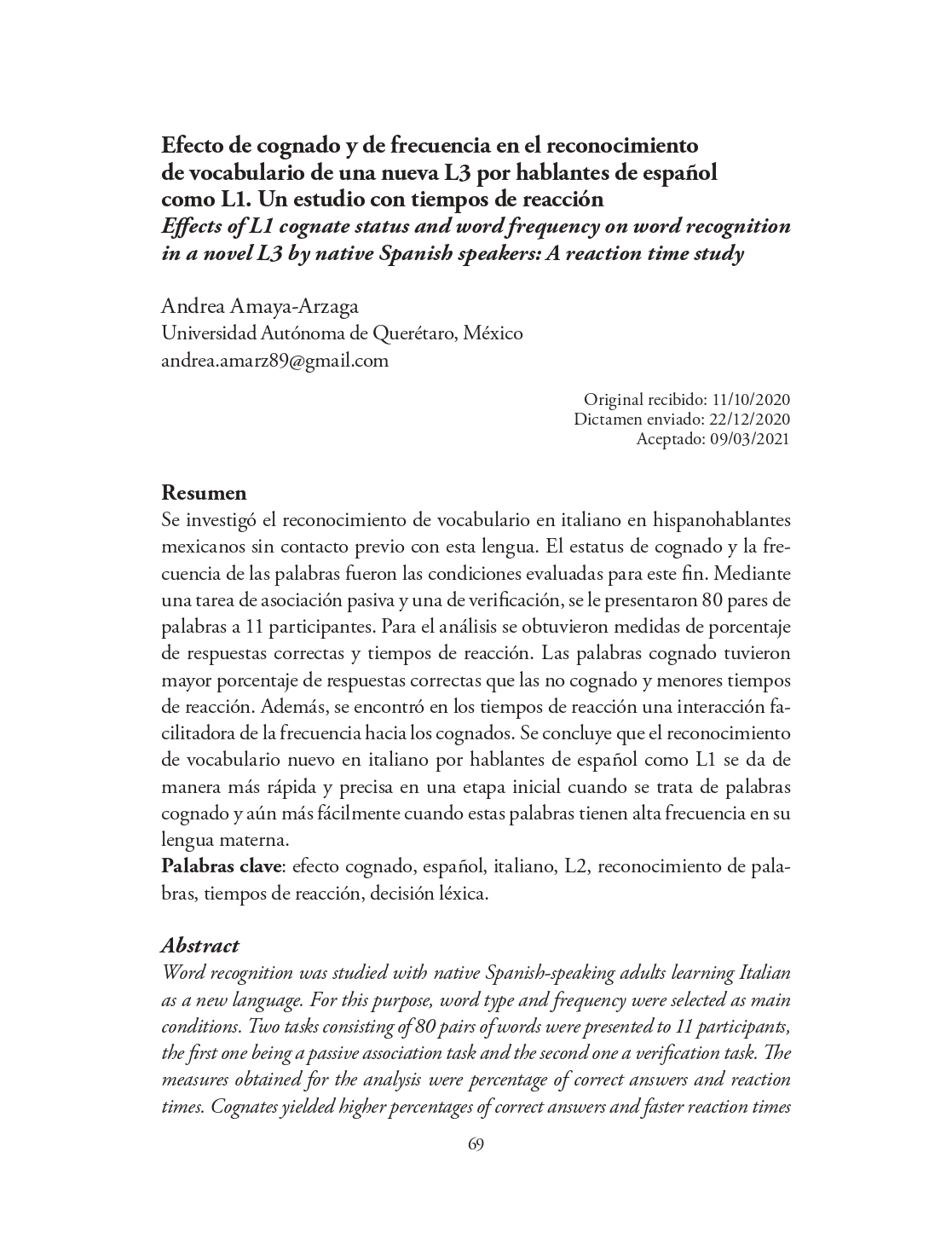
Word recognition was studied with native Spanish-speaking adults learning Italian as a new language. For this purpose, word type and frequency were selected as main conditions. Two tasks consisting of 80 pairs of words were presented to 11 participants,
the first one being a passive association task and the second one a verification task. The measures obtained for the analysis were percentage of correct answers and reaction times. Cognates yielded higher percentages of correct answers and faster reaction times than noncognates. Furthermore, an interaction was identified between cognate status and word frequency, with high frequency words favoring faster reaction times for cognates only. It can be concluded that the recognition of new Italian vocabulary by L1 Spanish speakers is faster and more accurate during initial stages of learning when the targets are cognates, even more so when they are high frequency words in their native language.

This work is licensed under a Creative Commons Attribution-NonCommercial 4.0 International License.