Keywords
Spanish derivative morphology
written language in elementary school
How to Cite
Abstract
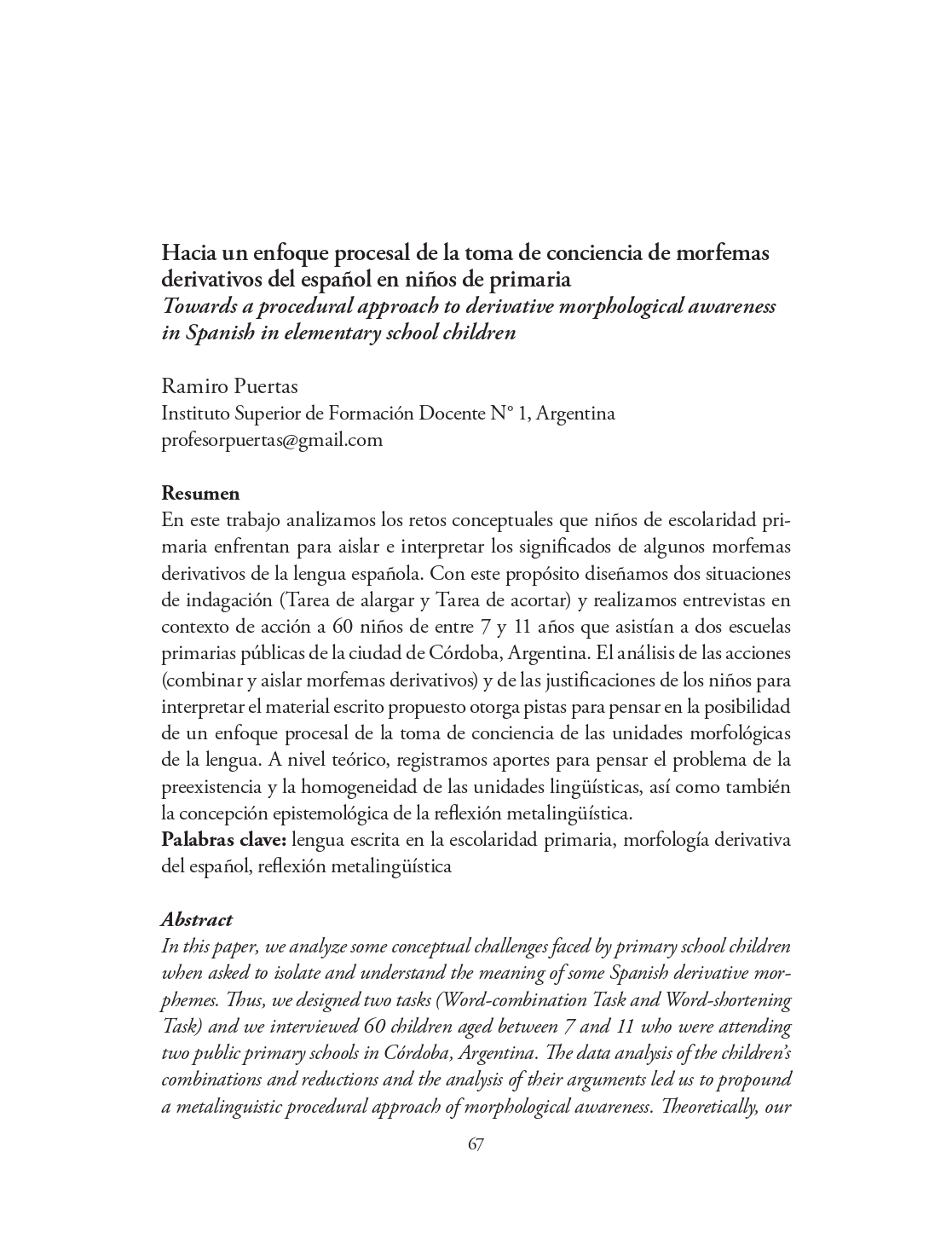
In this paper, we analyze some conceptual challenges faced by primary school children when asked to isolate and understand the meaning of some Spanish derivative morphemes. Thus, we designed two tasks (Word-combination Task and Word-shortening
Task) and we interviewed 60 children aged between 7 and 11 who were attending two public primary schools in Córdoba, Argentina. The data analysis of the children’s combinations and reductions and the analysis of their arguments led us to propound a metalinguistic procedural approach of morphological awareness. Theoretically, our research may contribute to dealing with the preexistence problem of language units and, hopefully, with the epistemological conception of metalinguistic awareness.

This work is licensed under a Creative Commons Attribution-NonCommercial 4.0 International License.