Keywords
Linguistic variation
loanword
How to Cite
Abstract
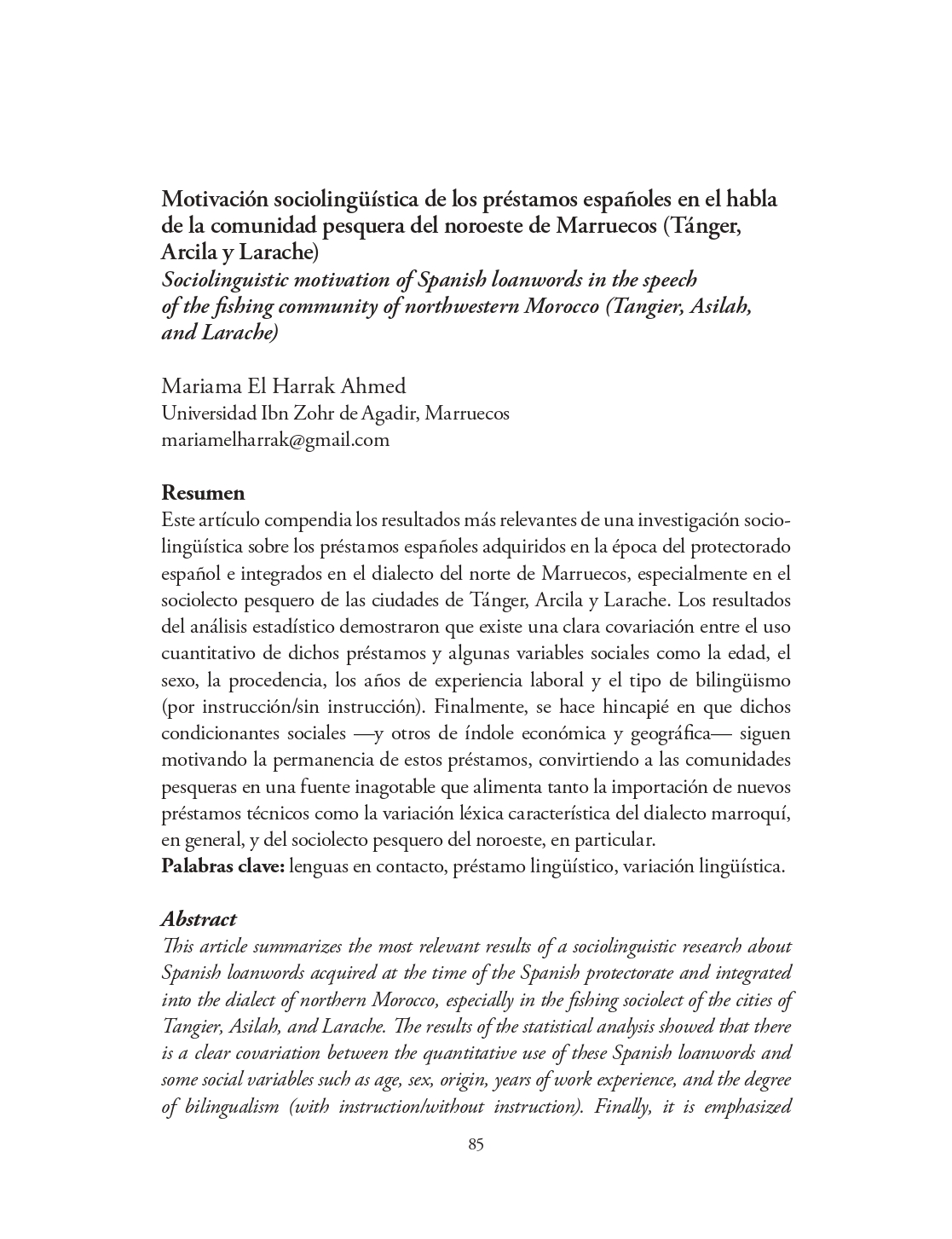
This article summarizes the most relevant results of a sociolinguistic research about Spanish loanwords acquired at the time of the Spanish protectorate and integrated into the dialect of northern Morocco, especially in the fishing sociolect of the cities of Tangier, Asilah, and Larache. The results of the statistical analysis showed that there is a clear covariation between the quantitative use of these Spanish loanwords and some social variables such as age, sex, origin, years of work experience, and the degree of bilingualism (with instruction/without instruction). Finally, it is emphasized that these social conditioning factors —and others of an economic and geographical nature— currently motivate the permanence of Spanish loanwords, and that fishing communities turn into an inexhaustible source that feeds both the importation of new technical loanwords and the lexical variation that characterizes the Moroccan dialect, in general, and the fishing speech of the northwest, in particular.

This work is licensed under a Creative Commons Attribution-NonCommercial 4.0 International License.