
Keywords
subordination
temporal relation
How to Cite
Abstract
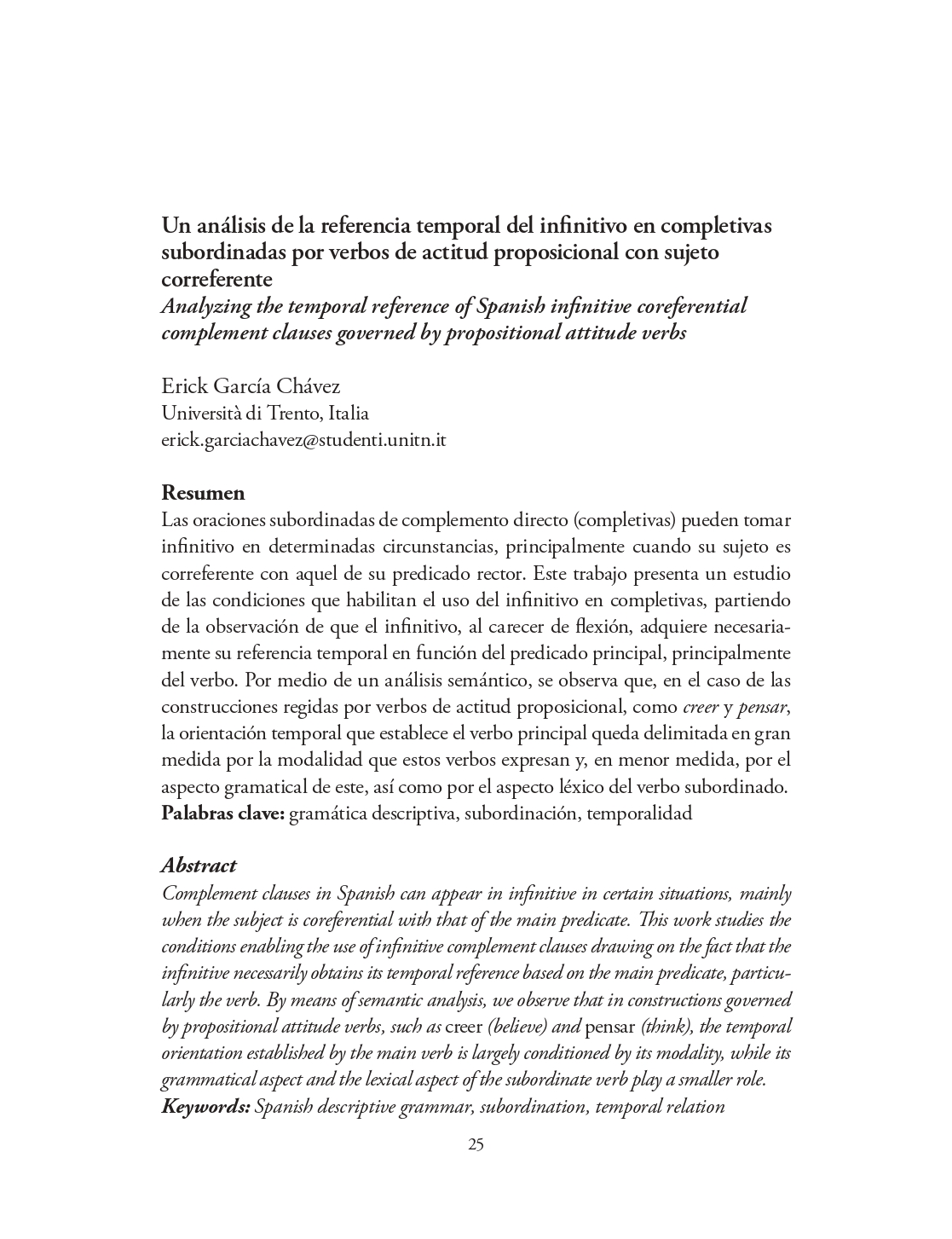
Complement clauses in Spanish can appear in infinitive in certain situations, mainly when the subject is coreferential with that of the main predicate. This work studies the conditions enabling the use of infinitive complement clauses drawing on the fact that the
infinitive necessarily obtains its temporal reference based on the main predicate, particularly the verb. By means of semantic analysis, we observe that in constructions governed by propositional attitude verbs, such as creer (believe) and pensar (think), the temporal orientation established by the main verb is largely conditioned by its modality, while its grammatical aspect and the lexical aspect of the subordinate verb play a smaller role.

This work is licensed under a Creative Commons Attribution-NonCommercial 4.0 International License.